Let A, B and C be sets such that A ∪ B = A ∪ C and A ∩ B = A ∩ C. Show that B = C.
SponsoredDesktop Banner
Answer
1
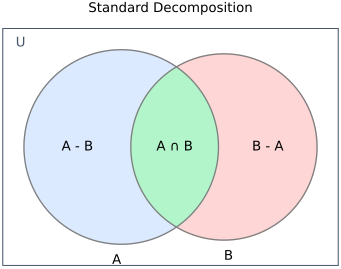
Write sets B and C as the union of their parts inside and outside set A by using the standard decomposition. Use the Venn diagram to visualize the decomposition for A and B, and apply the same idea to A and C.
Standard decomposition regions for A and B
B = (B - A) $∪$ (A $∩$ B)
C = (C - A) $∪$ (A $∩$ C)
2
Use A ∪ B = A ∪ C to compare the parts outside A.Trick: From standard decomposition, A ∪ B = A ∪ (B - A) and A ∪ C = A ∪ (C - A)
Let x $∈$ (B - A), so x $∈$ B and x $∉$ A
Since x $∈$ B, x $∈$ (A $∪$ B)
Given A $∪$ B = A $∪$ C, x $∈$ A $∪$ C
Since x $∉$ A, it follows that x $∈$ C. Therefore, x $∈$ (C - A)
Thus, B − A $⊂$ C − A. Similarly, C − A $⊂$ B − A
Therefore, B - A = C - A
3
Use A ∩ B = A ∩ C and B - A = C - A. Substitute these in the decomposition of B from Step 1.
Answer: B = (B - A) $∪$ (A $∩$ B) = (C - A) $∪$ (A $∩$ C) = C