Chapter 1: Sets
Chapter 1: Sets
Exercise
Question
Question: 4
9 / 17
9 / 17
Show that the following four conditions are equivalent:
(i) A ⊂ B (ii) A - B = ∅ (iii) A ∪ B = B (iv) A ∩ B = A
SponsoredDesktop Banner
Answer
1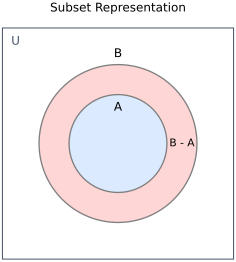
A ⊂ B: All elements of A are also elements of B
Observe the Venn diagram to relate the conditions A ⊂ B and A - B = ∅.
• If A $⊂$ B, then every element of A belongs to B. Therefore, when we remove all elements of B from set A, no element remains. Hence, A − B = $∅$.
• If A − B = $∅$, then removing the elements of B from set A leaves nothing. This means every element of A is also present in B. Hence, A $⊂$ B.
Hence, (i) $⇔$ (ii)
2
Use the Venn diagram in Step 1 to relate the conditions A ⊂ B and A ∪ B = B.
• If A $⊂$ B, then every element of A belongs to B. Therefore, adding set A to set B introduces no new elements. Hence, A $∪$ B = B.
• If A $∪$ B = B, then adding A to B does not introduce any new elements. Therefore, every element of A already belongs to B, so A $⊂$ B.
Hence, (i) $⇔$ (iii)
3
Use the Venn diagram in Step 1 to relate the conditions A ⊂ B and A ∩ B = A.
• If A $⊂$ B, then every element of A belongs to B. Therefore, the common elements of A and B are exactly the elements of A. Hence, A $∩$ B = A.
• If A $∩$ B = A, then every element of A is common to both sets. Therefore, every element of A belongs to B, so A $⊂$ B
Hence, (i) $⇔$ (iv)
4
Combine the equivalences proved in the previous steps.
Answer: Since (i) $⇔$ (ii), (i) $⇔$ (iii), and (i) $⇔$ (iv), all four conditions are equivalent.
Therefore, (i) $⇔$ (ii) $⇔$ (iii) $⇔$ (iv)