Chapter 1: Sets
Chapter 1: Sets
Exercise
Question
Question: 9
16 / 17
16 / 17
Let A and B be sets. If A ∩ X = B ∩ X = ∅ and A ∪ X = B ∪ X for some set X, show that A = B.
(Hint: A = A ∩ (A ∪ X), B = B ∩ (B ∪ X) and use Distributive law.)
SponsoredDesktop Banner
Answer
1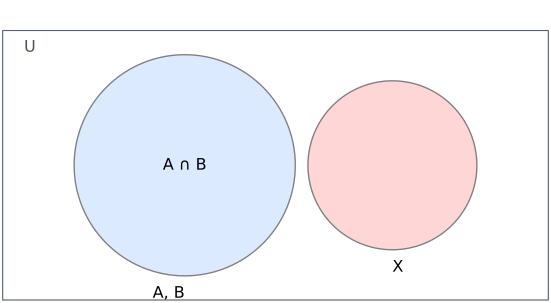
A ∩ X = B ∩ X = ∅, and A ∪ X = B ∪ X
Start with the identity A = A ∩ (A ∪ X) and use the given condition A ∪ X = B ∪ X
A = A $∩$ (A $∪$ X) = A $∩$ (B $∪$ X)
2
Apply the Distributive law and use the fact that A and X are disjoint.
A = A $∩$ (B $∪$ X) = (A $∩$ B) $∪$ (A $∩$ X)
Since A $∩$ X = $∅$, A = (A $∩$ B) $∪$ $∅$ = A $∩$ B
3
Start with the identity B = B ∩ (B ∪ X) and use the given condition A ∪ X = B ∪ X
B = B $∩$ (B $∪$ X) = B $∩$ (A $∪$ X)
4
Apply the Distributive law and use the fact that B and X are disjoint
B = B $∩$ (A $∪$ X) = (B $∩$ A) $∪$ (B $∩$ X)
Since B $∩$ X = $∅$, B = (B $∩$ A) $∪$ $∅$ = B $∩$ A
5
Compare the expressions obtained for A and B.
Answer: Since A = A $∩$ B and B = B $∩$ A = A $∩$ B, both A and B are equal to A $∩$ B. Therefore A = B.