Chapter 1: Orienting Yourself: The Use of Coordinates
Chapter 1: Orienting Yourself: The Use of Coordinates
Exercise
Question
Question: 1 (iii)
3 / 4
3 / 4
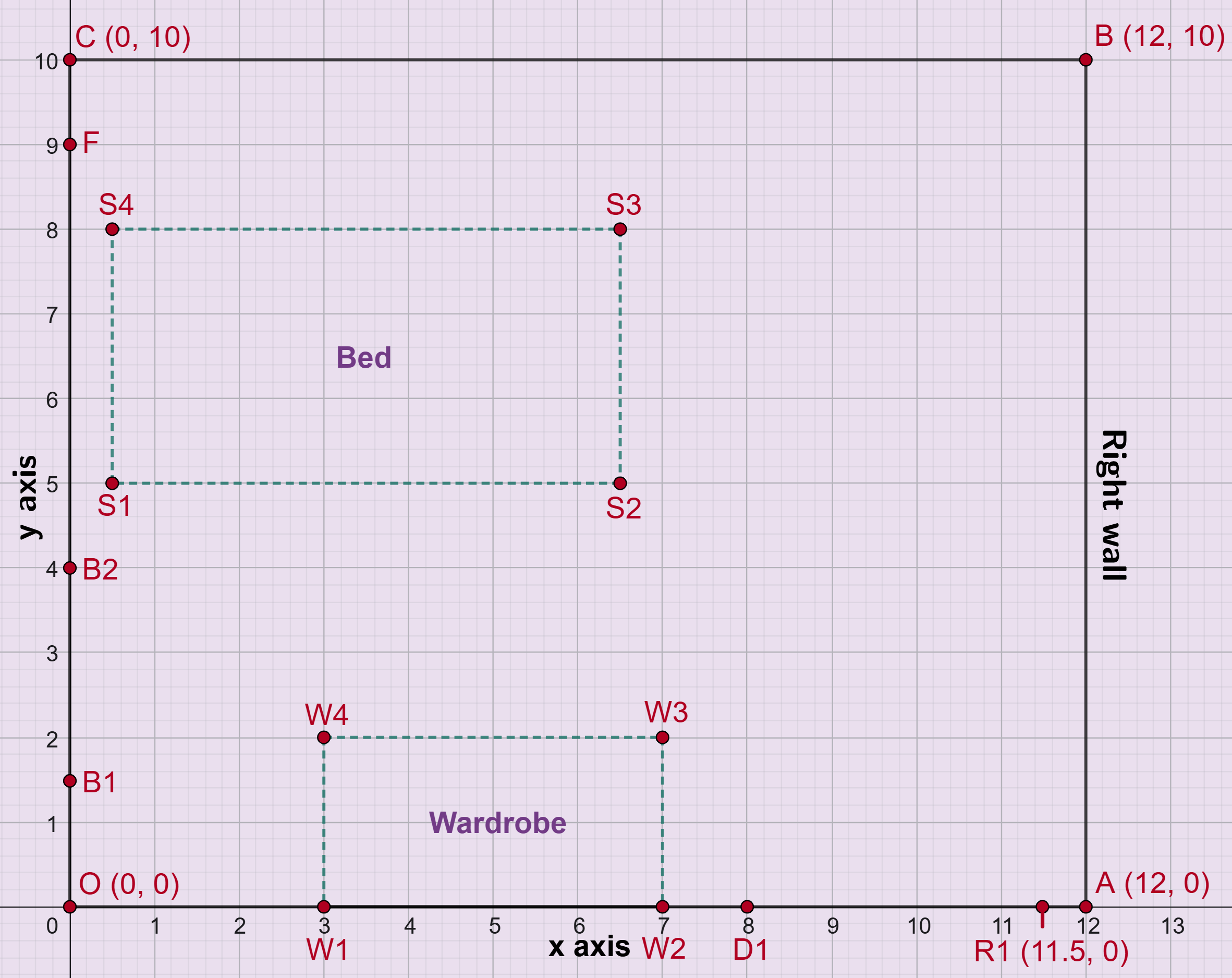
Fig 1.3 shows Reiaan's room with points OABC marking its corners. The x- and y-axes are marked in the figure. Point O is the origin.
Referring to Fig. 1.3, answer the following questions:
(iii) If R1 is the point (11.5, 0), how wide is the door? Do you think this is a comfortable width for the room door? If a person in a wheelchair wants to enter the room, will he/she be able to do so easily?
SponsoredDesktop Banner
Answer
1
Check the previous part for the coordinates of D1. Then find the horizontal distance between D1 and R1 using their x-coordinates.
Answer: The width of the door is 3.5 units.
Reason: From the previous part, D1 = (8, 0). The other end is R1 = (11.5, 0). Therefore, the width of the door is 11.5 - 8 = 3.5 units.
2
Compare the door width with a typical room door width.
Answer: Yes, the door is comfortably wide enough for a typical room door.
Reason: If each unit represents one foot, the door is 3.5 feet wide, which is a comfortable width for a typical room door.
3
Compare the door width with the width needed for a wheelchair user to pass through.
Answer: Yes, the door is wide enough for a typical wheelchair to pass through comfortably.
Reason: The door is 3.5 units wide. If each unit represents one foot, the door is 3.5 feet wide, which is wider than the typical width of a wheelchair. Therefore, a wheelchair user should be able to pass through the door comfortably.