Chapter 1: Orienting Yourself: The Use of Coordinates
Chapter 1: Orienting Yourself: The Use of Coordinates
Exercise
Question
Question: 2
4 / 9
4 / 9
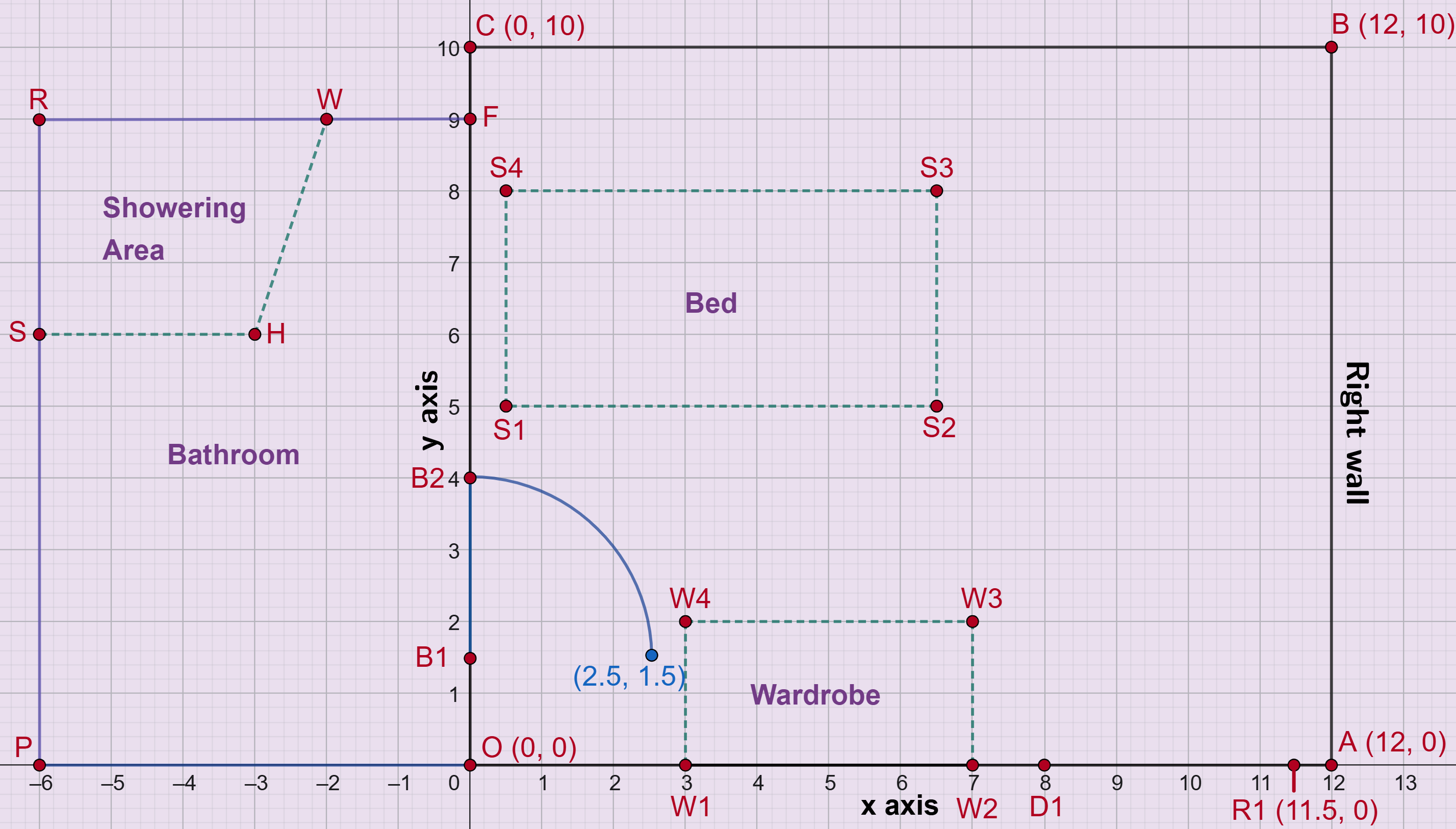
If the bathroom door has a hinge at B1 and opens into the bedroom, will it hit the wardrobe? Are there any changes you would suggest if the door is made wider?
SponsoredDesktop Banner
Answer
1
Find the width of the bathroom door using the y-coordinates of its two ends, B1 and B2.
Reiaan's room with the bathroom door open
The y-coordinates of the two ends of the bathroom door are 1.5 and 4. Therefore, the width of the door is 4 - 1.5 = 2.5 units.
2
Find the coordinates of the other end of the door after it swings 90° about its hinge at B1.
\text{The hinge B1 is at (0, 1.5). After a 90° swing, the other end B2 moves horizontally by 2.5 units, the width of the door. Therefore, the new coordinates of B2 are (0 + 2.5, 1.5) = (2.5, 1.5). $\quad$ ${color:#625b5f}[After the 90° swing, B2 has the same y-coordinate as B1.]{/color}$}
3
Check whether the door will hit the wardrobe by comparing its maximum x-coordinate with the nearest x-coordinate of the wardrobe.
Answer: No, the bathroom door will not hit the wardrobe.
Reason: The nearest end of the wardrobe is at x = 3. The free end of the door reaches a maximum x-coordinate of 2.5 when the door swings 90°. Therefore, the door remains 3 - 2.5 = 0.5 units away from the wardrobe and will not hit it.
4
If the door is made wider, think of different ways to prevent it from hitting the wardrobe when it opens.
Suggestions:
1. Re-hinge the door so that it opens into the bathroom instead of the room.
2. Move the wardrobe farther away from the door by at least the amount by which the door width increases.