Chapter 1: Orienting Yourself: The Use of Coordinates
Chapter 1: Orienting Yourself: The Use of Coordinates
Exercise
Question
Question: 15 (i)
23 / 25
23 / 25
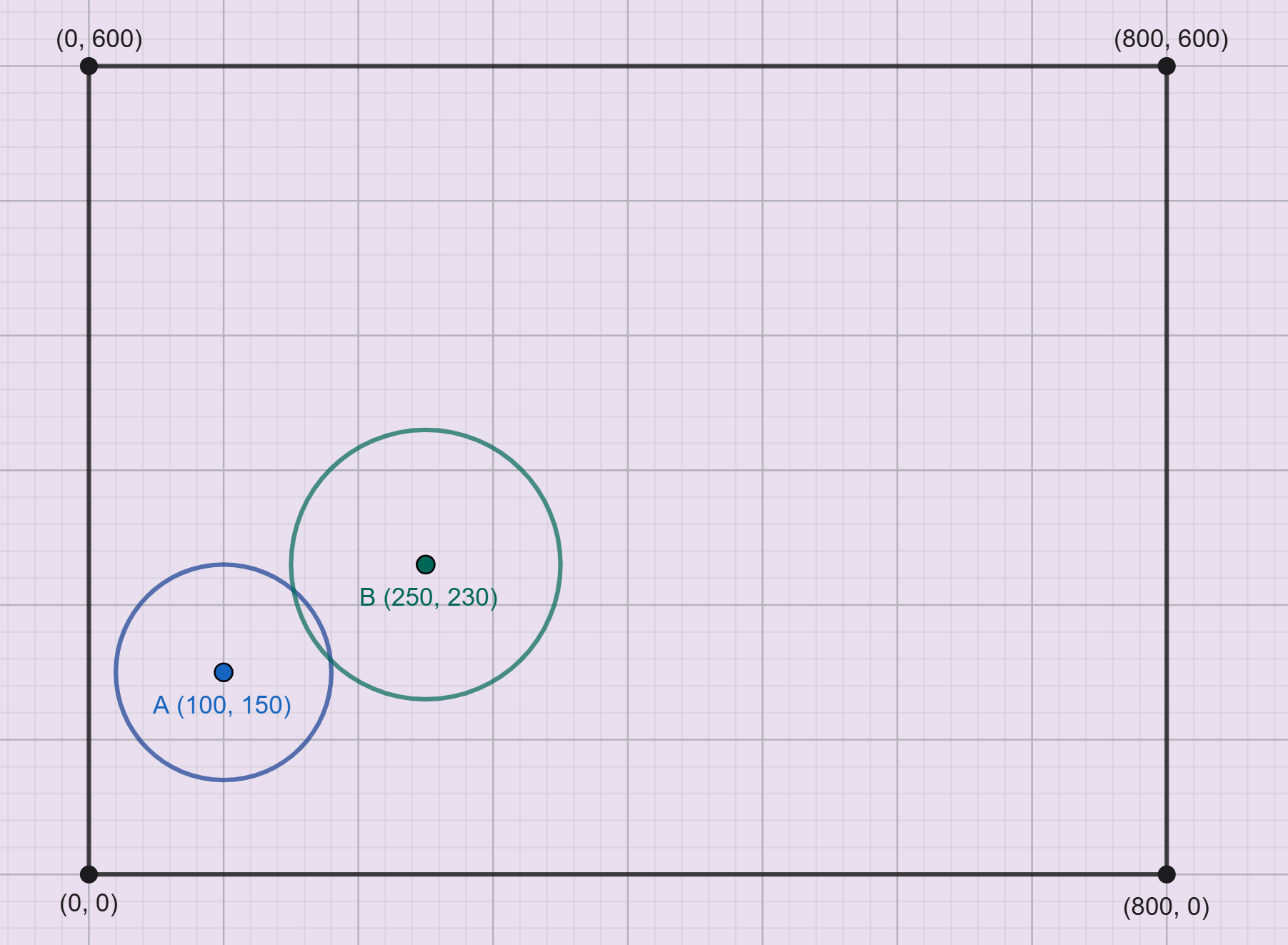
A computer graphics program displays images on a rectangular screen whose coordinate system has the origin at the bottom-left corner. The screen is 800 pixels wide and 600 pixels high. A circular icon of radius 80 pixels is drawn with its centre at the point A (100, 150). Another circular icon of radius 100 pixels is drawn with its centre at the point B (250, 230). Determine:
(i) whether any part of either circle lies outside the screen.
SponsoredDesktop Banner
Answer
1
The first circle is centred at A (100, 150) and has radius 80 pixels. Find its leftmost, rightmost, topmost, and bottommost points.
\text{Leftmost point = (100 - 80, 150) = (20, 150) $\quad$ ${color:#625b5f}[Reduce x-coordinate by the radius.]{/color}$}
\text{Rightmost point = (100 + 80, 150) = (180, 150) $\quad$ ${color:#625b5f}[Increase x-coordinate by the radius.]{/color}$}
\text{Topmost point = (100, 150 + 80) = (100, 230) $\quad$ ${color:#625b5f}[Increase y-coordinate by the radius.]{/color}$}
\text{Bottommost point = (100, 150 - 80) = (100, 70) $\quad$ ${color:#625b5f}[Reduce y-coordinate by the radius.]{/color}$}
2
The second circle is centred at B (250, 230) and has radius 100 pixels. Find its leftmost, rightmost, topmost, and bottommost points.
\text{Leftmost point = (250 - 100, 230) = (150, 230) $\quad$ ${color:#625b5f}[Reduce x-coordinate by the radius.]{/color}$}
\text{Rightmost point = (250 + 100, 230) = (350, 230) $\quad$ ${color:#625b5f}[Increase x-coordinate by the radius.]{/color}$}
\text{Topmost point = (250, 230 + 100) = (250, 330) $\quad$ ${color:#625b5f}[Increase y-coordinate by the radius.]{/color}$}
\text{Bottommost point = (250, 230 - 100) = (250, 130) $\quad$ ${color:#625b5f}[Reduce y-coordinate by the radius.]{/color}$}
3
Compare the leftmost, rightmost, topmost, and bottommost points of each circle with the screen boundaries.
Both circles lie completely within the screen boundaries.
Answer: Neither circle has any part outside the screen.
Reason: The screen covers 0 $≤$ x $≤$ 800 and 0 $≤$ y $≤$ 600. Circle A extends from x = 20 to 180 and y = 70 to 230, while circle B extends from x = 150 to 350 and y = 130 to 330. All these ranges lie within the screen boundaries. Therefore, both circles lie completely inside the screen.