Chapter 1: Orienting Yourself: The Use of Coordinates
Chapter 1: Orienting Yourself: The Use of Coordinates
Exercise
Question
Question: 16
25 / 25
25 / 25
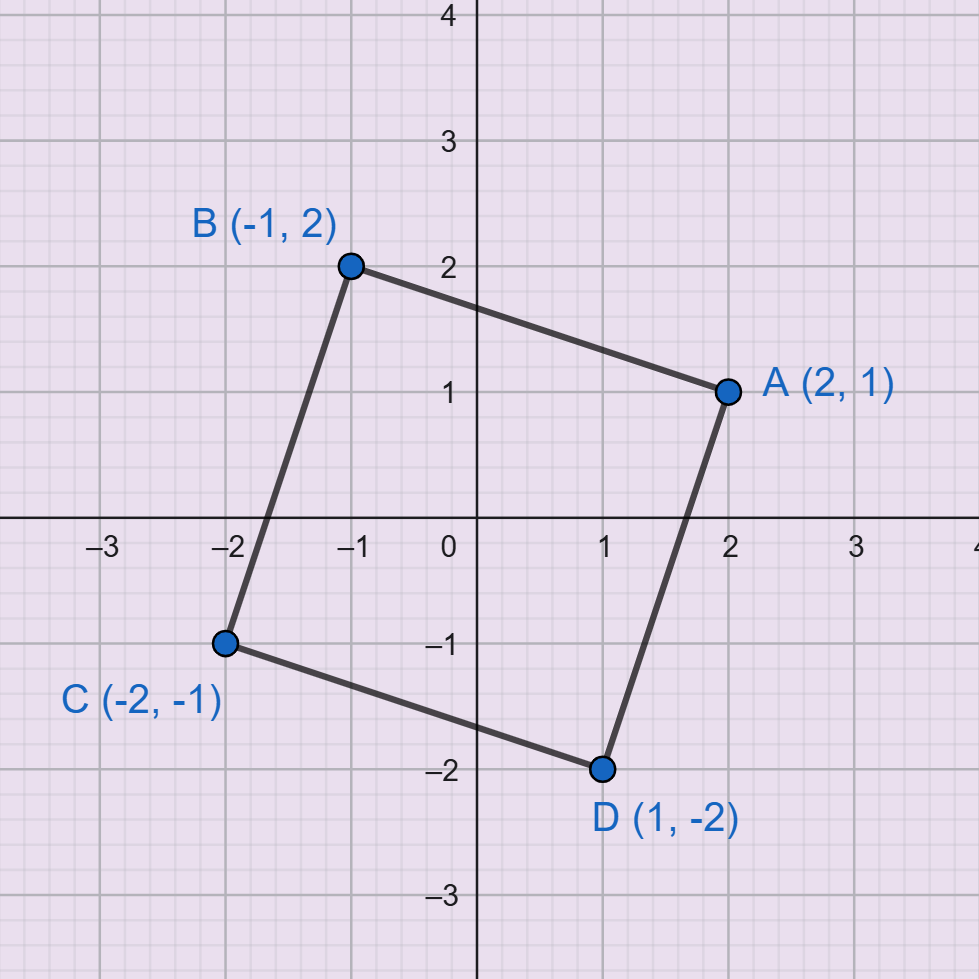
Plot the points A (2, 1), B (-1, 2), C (-2, -1) and D (1, -2) in the coordinate plane. Is ABCD a square? Can you explain why? What is the area of this square?
SponsoredDesktop Banner
Answer
1
Find the lengths of all four sides of quadrilateral ABCD using the distance formula.
Check whether all four sides are equal and whether the two diagonals are equal to determine whether ABCD is a square.
Answer: ABCD is a square.
\textbf{Reason: All four sides of ABCD are equal, with each side measuring $\sqrt{10}$, and the two diagonals are also equal, with each measuring $\sqrt{20}$. Therefore, ABCD is a square.}
Quadrilateral ABCD is a square.
4
Use the side length of the square to calculate its area.
Answer: Area of square ABCD = 10 square units.
\textbf{Reason: The side length is $\sqrt{10}$. Therefore, Area = $(side)^2 = (\sqrt{10})^2 = 10$. So, the area of ABCD is 10 square units.}