Compare the sum of the two smaller distances with the largest distance. If the sum is equal to the largest distance, the three points are collinear.
Answer: No. The points R, B, and C do not lie on the same straight line.
\textbf{Reason: The two smaller distances are RB = 5 and BC = $\sqrt{85}$ $\simeq$ 9.22, while the largest distance is CR = $\sqrt{202}$ $\simeq$ 14.21. Their exact sum is 5 + $\sqrt{85}$, which is not equal to $\sqrt{202}$. Therefore, R, B, and C are not collinear.}
3
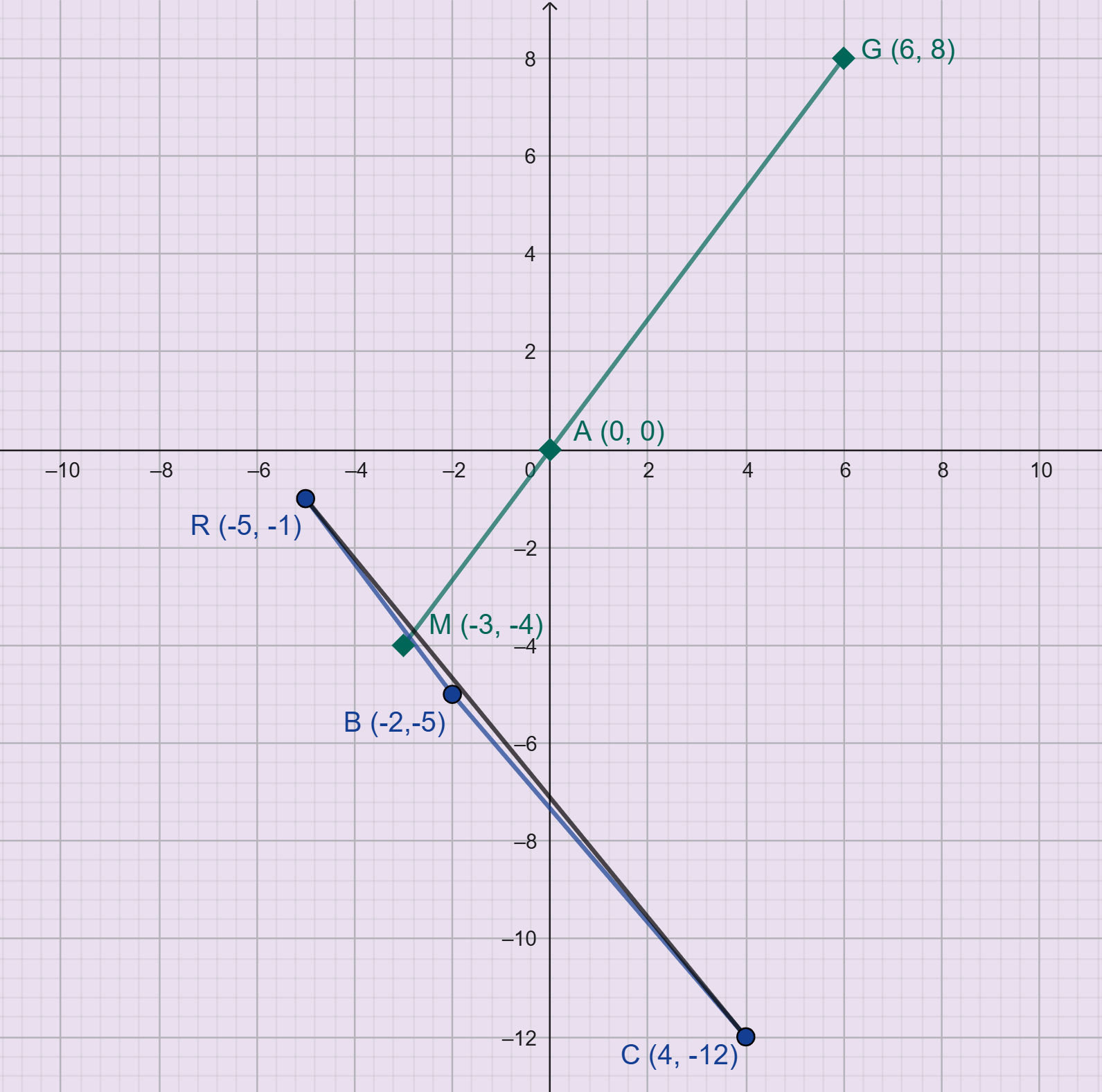
Plot both sets of points and join each set in the given order. Check whether the three points in each set lie on the same straight line.
Answer: The graph confirms our results.
Reason: M, A, and G lie on the same straight line, while R, B, and C do not. The graph confirms the results obtained using the distance method.
Graph verifying that M, A, and G are collinear, while R, B, and C are not.