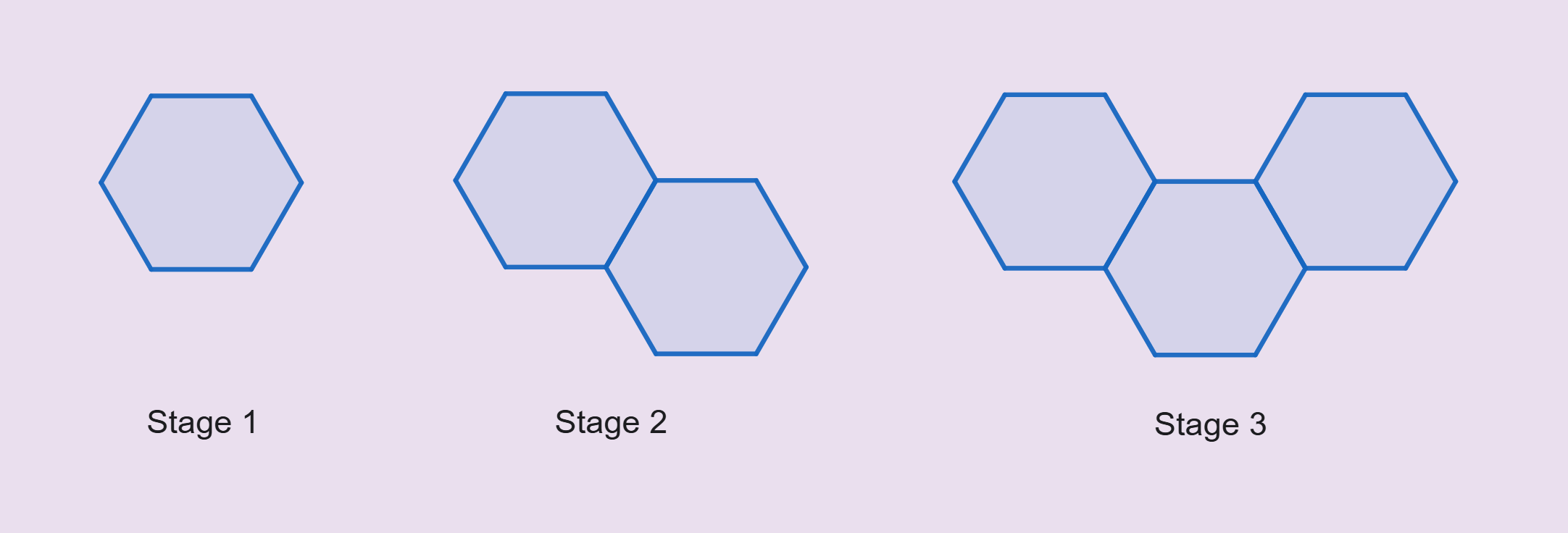
Look at the first three stages of a growing pattern of hexagons made using matchsticks. A new hexagon gets added at every stage which shares a side with the last hexagon of the previous stage.
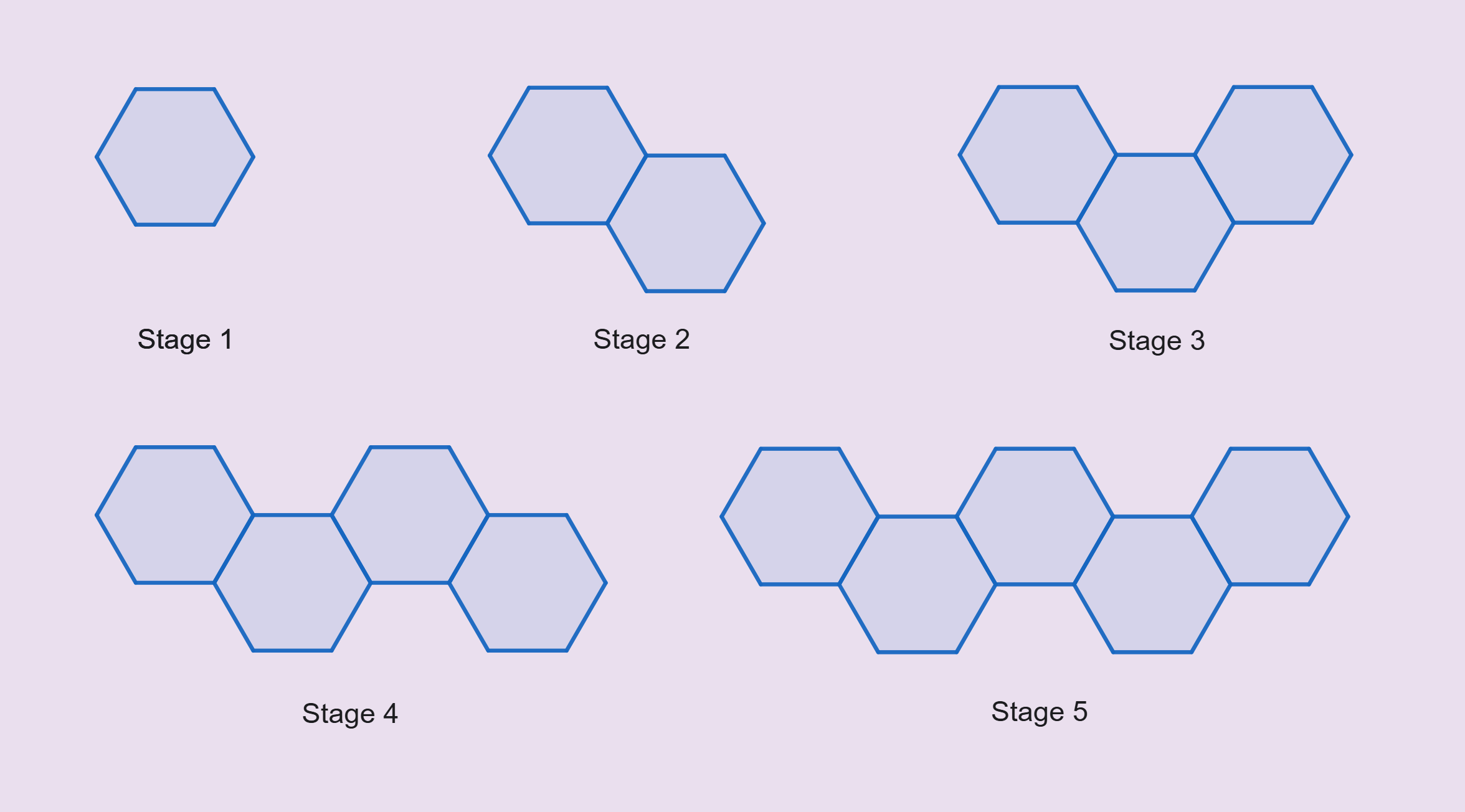
(i) Draw the next two stages of the pattern. How many matchsticks will be required at these stages?
First three stages of a growing hexagon pattern made using matchsticks
SponsoredDesktop Banner
Answer
1
Count the matchsticks in the given stages.
Stage 1 = 6 matchsticks
Stage 2 = 6 + 5 = 11 matchsticks
Stage 3 = 6 + 5 + 5 = 16 matchsticks
2
Find how the number of matchsticks increases from one stage to the next.
Stage 2 - Stage 1 = 11 - 6 = 5
Stage 3 - Stage 2 = 16 - 11 = 5
3
Determine the linear for the number of matchsticks in the nth stage.
Matchsticks in Stage 1 = 6
\text{Matchsticks added at each new stage = 5 $\quad$ ${color:#625B5F}[For example, Stage 2 = 6 + 5 = 11 matchsticks]{/color}$}
Hence, the number of matchsticks $c$ in the $n$th stage is $c = 6 + 5(n - 1)$
4
Find the number of matchsticks in the 4th and 5th stages.